If you have been looking into ductless cooling options, you have probably come across the term mini split without always getting a clear answer about what your actual choices are. There are several types of indoor units available, and the right one depends on your space, your ceiling layout, and how you want the system to fit into your home aesthetically and practically.
This guide breaks down what a ductless mini split air conditioner is, the three main types of indoor heads available, and how to decide which one makes sense for your situation on the Northshore.
What Is a Ductless Mini Split Air Conditioner?
A ductless mini split system conditions your home without using air ducts. Where a traditional central air system pushes conditioned air through a network of ducts to every room, a mini split connects an outdoor compressor directly to one or more indoor air handling units, called heads, installed in the rooms you want to condition.
Each indoor head has its own fan and evaporator coil and controls the temperature in its zone independently. A single outdoor unit can support multiple indoor heads, which makes these systems very flexible for homes with different room layouts or areas that a central system cannot reach effectively.
The connection between the outdoor and indoor units is a small conduit that runs through the wall, carrying refrigerant lines, a power cable, and a condensate drain. No ductwork is required.
Ductless AC systems are a particularly strong fit for the Northshore because of how well variable-speed units handle humidity. In St. Tammany Parish and the surrounding area, where humidity is high for most of the year, a mini split running at lower speeds for longer periods removes significantly more moisture from the air than a system that cycles aggressively on and off. That sustained operation is what keeps rooms feeling truly comfortable rather than just cool.
The Three Types of Ductless Mini Split Indoor Heads
High Wall Mount
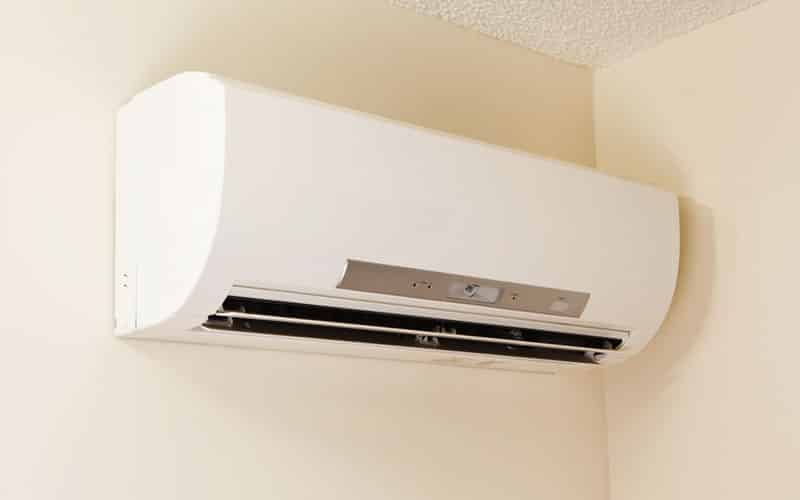
The high wall mount is the most common type of ductless indoor unit. It attaches to an interior wall near the ceiling and distributes conditioned air downward across the room.
Best for: Bedrooms, living rooms, garages, sunrooms, home additions, and any standard room with available interior wall space.
Pros:
- The most affordable to purchase and install of all three types
- Easiest to access for filter cleaning and routine maintenance
- Widest range of sizes and capacities available
- Often includes the most advanced features, such as occupancy detection and directional airflow control
- Straightforward installation with minimal modification to the wall
Cons:
- Visible on the wall and extends several inches into the room
- Some homeowners prefer a more discreet option for formal living areas
For the large majority of Northshore homes and applications, a high wall mount is the right starting point. It costs the least, performs reliably, and is the easiest to service over time. If there is no specific reason to choose one of the other types, this is the one to use.
Floor Mount
A floor mount unit installs low on the wall, near the floor, rather than up near the ceiling. It can be recessed slightly into the wall to reduce how much it protrudes into the room, though it will still extend a few inches.
Best for: Rooms where high wall space is limited or unavailable, such as those with large windows reaching nearly to the ceiling, rooms with architectural features that block upper wall placement, attic conversions with sloped ceilings, or situations where the homeowner simply prefers airflow at a lower level.
Pros:
- Solves installation challenges where a high wall mount is not practical
- Good efficiency and performance
- Airflow at floor level can feel more natural in some spaces
Cons:
- Air distribution is less even in taller rooms because cool air pools near the floor rather than cascading down from above
- Typically does not include the same advanced occupancy detection features as high wall units due to its lower placement
- Can be partially obstructed by furniture if room layout does not allow adequate clearance
Floor mount units are a practical solution for rooms where a high wall mount simply does not fit. They are not the first recommendation for a standard room, but they are reliable when the situation calls for them.
Ceiling Cassette
A ceiling cassette is installed inside a ceiling opening so that only the grille is visible, flush with the ceiling surface. Air is distributed outward in multiple directions from the center of the unit, which can provide more even coverage across a larger or more open space.
Best for: Open floor plans, commercial spaces, or homeowners who want the indoor unit to be as visually unobtrusive as possible and who have the ceiling structure to support it.
Pros:
- The most discreet option, with only a grille visible at the ceiling
- Good air distribution in open or square-shaped rooms
- Works well when wall space is unavailable on any wall
Cons:
- Significantly more expensive to install because ceiling framing work must be completed before the unit can go in
- Requires a condensate pump to push moisture upward against gravity for drainage, which adds a component that needs periodic maintenance and can produce noise when running
- More difficult to access for filter cleaning and routine service
- Typically does not include the same advanced sensor technology as high wall mount units
Ceiling cassettes make sense in the right application. They are not a general recommendation for standard bedrooms or living rooms but are a strong fit for specific commercial or aesthetic requirements.
Single-Zone vs. Multi-Zone Systems
Single-Zone
A single-zone mini split pairs one outdoor unit with one indoor head. It is the most affordable starting point and the right choice when you need to condition one specific space independently.
Common single-zone applications on the Northshore include:
- Garages and workshops, where ductwork is not code-compliant
- Converted rooms or home additions that are not connected to the existing duct system
- A sunroom that becomes unusable in summer
- A bedroom or home office that runs significantly warmer than the rest of the house despite a working central system
- A guest suite where independent temperature control is preferred
Multi-Zone
A multi-zone system connects one outdoor unit to two or more indoor heads, each controlling its own space independently. Each zone can run at a different set point or be turned off entirely while the others continue operating.
Multi-zone systems are a strong fit for homes without existing ductwork, for whole-home coverage as a replacement for or alongside central AC, and for any situation where individual room control is a priority.
One thing to keep in mind: the outdoor unit has a total cooling capacity. Adding more indoor heads means that capacity is shared across all zones. Your installer will size the outdoor unit to handle the combined load. Running all zones simultaneously may limit how aggressively each one can cool compared to running one zone alone.
Cooling Only vs. Heat Pump
Most ductless mini splits sold today function as heat pumps, meaning they both cool in summer and heat in winter using the same refrigerant system. For Northshore homeowners, this is almost always the right configuration.
A cooling-only unit cannot be converted to add heating capability after installation. Given that the Northshore does see stretches of cold weather in December and January where supplemental heat is useful, and given that the cost difference between a cooling-only unit and a heat pump is generally small, there is little reason to choose cooling-only for a Louisiana home.
When a Mini Split Makes Sense on the Northshore
- Home additions, converted garages, or sunrooms not connected to existing ducts
- Older homes built before central air was standard and not practical to duct
- Any room that consistently runs too warm or too humid regardless of what the central system’s thermostat is set to
- When your central AC needs replacement and you want to evaluate ductless as an alternative
- When indoor humidity is a persistent issue in specific rooms (variable-speed mini splits are outstanding at moisture removal)
- When you want independent temperature control in different rooms without modifying existing ductwork
What About Homes With Central Air Already?
If your home has a working central air system with ductwork in good condition, you do not necessarily need to replace it with a mini split. Many Northshore homeowners keep their central system for main living areas and add a single-zone ductless AC unit for a problem room, a bonus space, or a converted area.
If your central system is running but comfort is still an issue, an AC maintenance visit can identify whether the existing equipment can be improved before adding new equipment to the picture. The issue may be something as simple as a dirty coil, a refrigerant level that is slightly off, or a duct problem that is limiting airflow to certain rooms.
For humidity issues specifically, the indoor air quality team can evaluate whether a dedicated dehumidifier or air quality solution would solve the problem more directly than new HVAC equipment.
Brands We Install
Southern Air installs ductless systems from Mitsubishi, Daikin, Carrier, and American Standard. All are proven brands with strong performance records in Louisiana’s demanding climate.
Ready to Talk About a Ductless Mini Split for Your Northshore Home?
Southern Air has been serving the Northshore since 1984. Our team will evaluate your home, recommend the right head type and configuration, and provide upfront pricing before any work begins. We also offer flexible financing and check our specials page for current offers.
Call us at (985) 200-5442 or schedule a consultation online to get started.